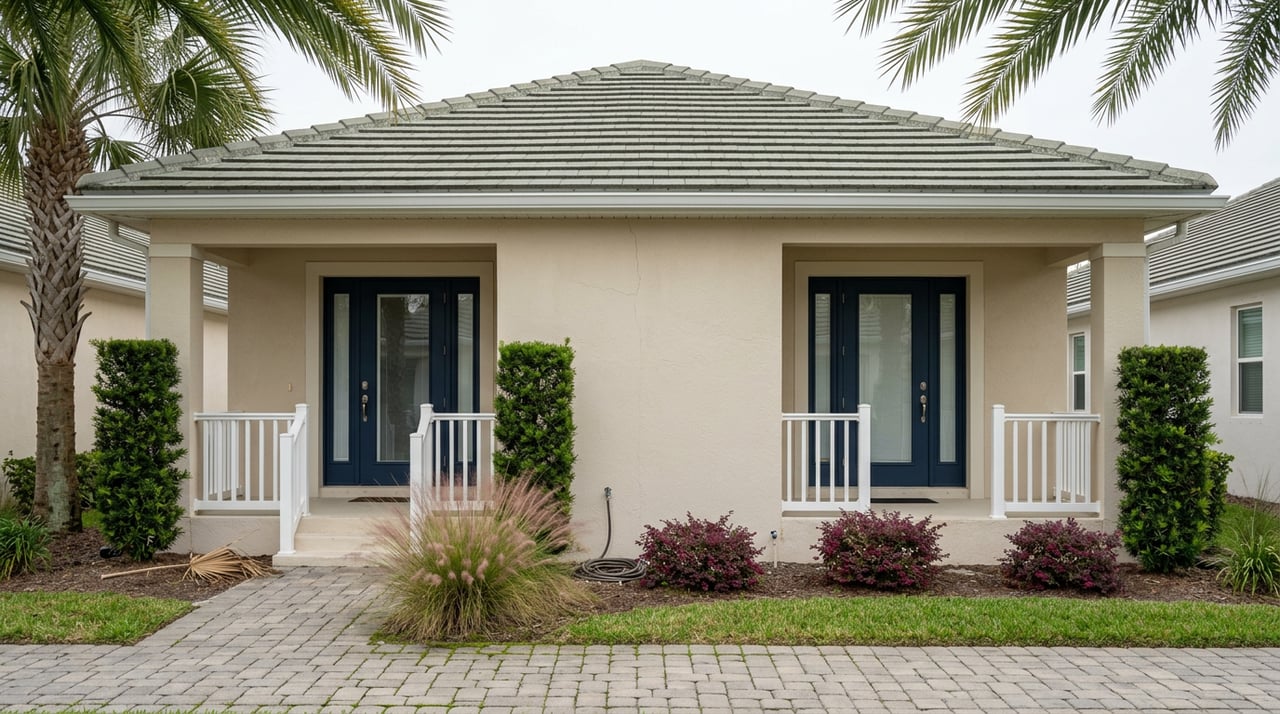
Jared Shope owns a unit at Sea Side Villas in Forest Beach. In a case reported in 2023, his regime fee ran $4,860 a year, a number he'd budgeted for and understood. Then the building's master insurance policy renewed at $690,577, up from $115,223 the year before, a jump of nearly 500 percent. Shope's share of covering that increase landed as a $4,000 special assessment on top of the fee he already paid. He told a local reporter he wasn't surprised the policy went up. He was surprised by how much.
Here's the detail that should stop a buyer mid-scroll on any Hilton Head villa listing: Sea Side Villas is one of the complexes on the island where building and flood insurance is already bundled into the monthly regime fee, not billed separately. That's supposed to be the safer structure. Buyers are often told to look for it. It didn't matter. When the premium moved that fast, the fee couldn't absorb it, and the association had to go back to owners anyway.
That's the thing the regime fee line on a listing sheet can't show you. It tells you what a complex charges today. It says nothing about what happens when a master insurance renewal comes in five times higher than last year, which is happening across Hilton Head condos and villas with enough frequency that property managers and insurance agents on the island now discuss it as a standing risk rather than a rare event.
The Bundling Question Buyers Ask Isn't the One That Protects Them
Villa buyers are usually coached to ask one question: does the regime fee include building and flood insurance, or is it billed separately as a special assessment? It's a reasonable question. Several well-known complexes handle it differently. Harbourside Villas in Palmetto Dunes and Bluff Villas in Sea Pines both exclude insurance from the standard monthly fee and bill it as a separate assessment to owners when premiums come due. Sea Side Villas, by contrast, folds building and flood coverage directly into its regime fee, a structure that sounds like it removes the surprise.
The Shope case shows why that distinction matters less than buyers assume. A bundled fee only protects you from surprise if the annual increase stays inside what the fee was set up to absorb. Beaufort County insurance agents have described condo master policies rising anywhere from zero to 500 percent in recent renewal cycles, driven by reinsurance costs, shrinking carrier appetite for coastal risk, and rebuild-cost inflation. When an increase runs at the extreme end of that range, no fee structure, bundled or not, keeps the bill from eventually reaching the owner. The question that actually protects a buyer isn't "is insurance in the fee." It's "what has this specific building's insurance renewal looked like over the past two to three years, and has the association had to levy a special assessment to cover it." That answer lives in board minutes and financial statements, not in the MLS remarks.
Same Plantation, Different Rules at the Regime Level
The second thing the listing sheet hides is which fees actually attach to the unit versus the community around it. Sea Pines Plantation itself charges no transfer fee to the Property Owners Association when a home or villa changes hands. That fact gets repeated often enough that buyers reasonably assume it applies to every villa complex inside the gates. It doesn't.
Bluff Villas, a Sea Pines complex, charges its own transfer fee at the regime level equal to twice the monthly regime amount, payable at closing regardless of what the parent POA charges. South Beach Villas, also in Sea Pines, charges no such fee. Both sit inside the same plantation, under the same POA rule of no transfer fee, and still land differently on a closing statement because the regime layer sets its own terms. Over at Palmetto Dunes, Harbourside Villas skips a formal transfer fee but still assesses a one-time $200 processing charge whenever ownership changes hands.
None of this shows up until someone pulls the actual regime documents for that specific complex, not the community's general reputation for fees.
The Town of Hilton Head Island's own Real Estate Transfer Fee, a flat 0.25 percent of the sale price collected on every property transaction within town limits, generates about $4.2 million a year, money earmarked entirely for the town's Land Acquisition Program.
That town-level fee is the one constant. It applies to every sale on the island, villa or single-family, gated or not, and funds a program the town has used to buy waterfront and historic tracts outright rather than let them go to private development. It's predictable, published, and the same for everyone. The regime-level fees stacked on top of it are the ones that vary complex to complex, and they're the ones a buyer has to go find.
What This Means When You're Actually Comparing Two Listings
As of mid-July 2026, Hilton Head Island carried roughly 4.6 months of housing inventory, a level real estate data trackers describe as a balanced market where supply and demand sit close to even. Redfin's trailing three-month figures through June 2026 put the median sale price at $767,000, down slightly from the same period a year earlier. That balance matters here specifically because it gives buyers something they didn't have during the tighter markets of recent years: time. In a market where offers had to move in days, few buyers had room to request three years of insurance renewal history or read regime board minutes before writing a contract. In a slower, more even market, that homework is realistic to do before you're locked in.
So when two villas show up at the same price, in the same complex or even the same plantation, with similar regime fee numbers on the listing, treat that number as a starting point rather than a comparison. Before writing an offer on either one, ask for:
- The complex's insurance renewal history for the past two to three years, not just the current premium
- Whether the regime has levied a special assessment for insurance, roofing, or exterior work in that same window
- The current reserve study and reserve balance, which shows whether the association is funding ahead of major repairs or catching up after the fact
- The specific transfer fee or processing charge tied to that regime, separate from whatever the parent POA or plantation charges
- Whether an HO6 policy will be required by your lender, since villa financing on Hilton Head typically requires owners to carry that coverage for interior improvements and personal property regardless of what the master policy covers
Two villas that look identical on paper can carry different real costs of ownership once these answers come back. The difference rarely shows up in the sale price. It shows up eighteen months later in a special assessment notice.
A Few Questions Worth Settling Before You Write an Offer
Does a lower regime fee always mean lower total cost? Not on its own. A complex with a lower monthly fee that hasn't funded insurance or reserves adequately can cost more in the first year of ownership than a complex with a higher fee and a documented history of absorbing renewals without assessments.
Can the Town's 0.25 percent transfer fee be negotiated away? No. It's a standard closing cost on every real estate transaction within Hilton Head Island town limits and applies the same way regardless of who negotiates what on the contract itself.
If a complex bundles insurance into the regime fee, does that guarantee no special assessment? No. Sea Side Villas bundles building and flood coverage into its monthly fee and still required a special assessment when its master policy renewal came in nearly five times higher than the prior year.
Do all Hilton Head villa purchases require separate personal insurance? Most lenders require an HO6 policy for financed villa and condo purchases, covering interior improvements, upgrades, and personal property that the master or regime policy typically doesn't reach.
Comparing two villas on price alone was never really comparing them. The fee structure, the insurance history, and the specific transfer terms attached to that one complex are where the actual difference in cost lives, and none of it shows up until you ask.
If you're weighing two Hilton Head villas and want help pulling the actual regime documents before you write an offer, Eoin O'Driscoll can walk through what each complex's numbers really mean for your budget. FOLLOW YOUR DREAM, HOME.